
In my 25-year career, one constant has shaped every chapter: curiosity. Whether it’s learning new technology, new ways of working, learning from new cultures in France, UK, Singapore and now Canada or designing new business models enabled by innovation. And in 2026, it’s never been more important. Graduates entering the job market without that very human curiosity and desire to keep learning will be the easiest to replace. Skills age quickly; curiosity compounds.
2025 is the year I built my first AI agent (for my Monthly Business Reviews), dived deep into the layers of data protection and security that are required for enterprise-wide GenAI adoption. On the personal side, curiosity meant discovering Carthagena and closer to home Prince Edward Island, Niagara river (yum!) and world-premiere movies at TIFF (Toronto International Film Festival). It also meant exploring new restaurants in beloved NYC for my birthday.
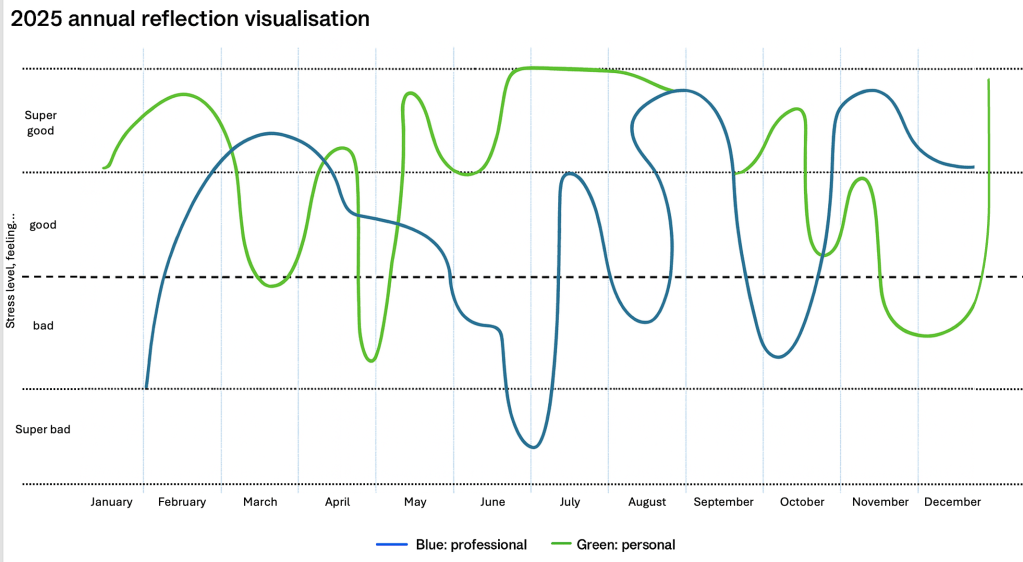
One way I ensure that curiosity turns into learning is by documenting and visualising my annual reflection. This is probably the 7th year in a row I’ve done this self-leadership exercise. It helps me be intentional and deliberate about where I invest my time and energy in the year ahead. I reflect on both at the feel-good moments and the less comfortable ones. High-stress situations often carry the richest learnings. I blend the personal and the professional because… we only have one life. It zigs and zags. Ideally, not everything is gloom at the same time and hopefully some stress at home or work is counter-acted with either boundaries or joy elsewhere.
What Sparked My Curiosity in 2025
Enterprise AI & Business Models
17 June 2025 – The AI Daily Brief: 16 Ways Enterprise AI Is Changing
A standout insight: outcome‑based AI pricing is still very early. Only 15% of CIOs prefer it, compared to 39% for usage‑based and 21% for seat‑based models. The biggest blockers?
- Lack of clear, measurable outcomes (47%)
- Unpredictable and unscalable costs (36%)
A useful reminder that technological capability often races ahead of commercial readiness.
25 July 2025 – The AI Daily Brief: How One Company Saved 213,000 Hours With AI
Norway’s $1.8T Sovereign Wealth Fund made AI core to how it operates—saving 213,000 hours annually. With tools like Claude, employees can query data in plain English, analyze earnings calls instantly, and make better decisions faster.
What struck me: AI was positioned not as a threat, but as a career accelerator.
14 July 2025 – a16z Podcast: Aaron Levie on Enterprise AI Adoption
A sharp take on why adoption is less about tools and more about change management, incentives, and trust.
30 May 2025 – The AI Daily Brief: Six AI Use-Case Primitives
OpenAI’s six recurring patterns for AI value creation:
- Content creation
- Research
- Coding
- Data analysis
- Ideation and strategy
- Automation
Simple, but powerful framing for prioritisation.
Boards, Governance & GenAI
February 2025 – Board Leadership Centre: Directors’ Quarterly Insights (#OnThe2025Agenda)
One line stayed with me: “Understanding the company’s overall approach to data governance—people, process, and technologies—should be a full‑board conversation and agenda priority.”
With GenAI, data governance risk goes far beyond technical compliance. I especially appreciated the framing of questions boards should be asking:
1. Alignment with strategy
- Is the data governance framework aligned with strategic goals?
- Which strategic priorities are most data‑dependent?
- Is the C‑suite aligned on data governance priorities?
2. Structure and accountability
- How is data governance operationally structured?
- Who owns what?
- How do roles across CDO, CIO, CISO, and Compliance intersect?
And for boards themselves:
- Is the audit committee overloaded?
- Does another committee have the skills and time to oversee cyber, data, and tech risk?
- Is there a case for a dedicated technology or risk committee?
Curiosity isn’t just a mindset. It’s a practice. In the age of GenAI, it remains one of the most durable human advantages we have.
 Virginie Pontruché